Welcome: Jiangmen LEDER Lighting Co., Ltd.
 بالعربية
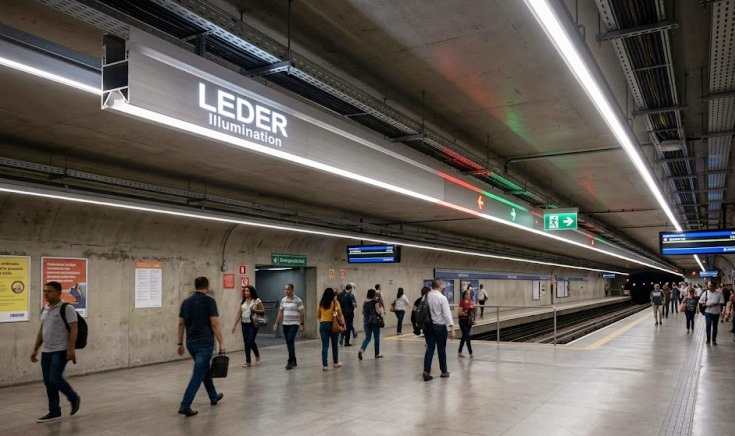
The Concept: Mainless lighting in transit hubs shifts away from bulky, traditional point-source fixtures to continuous, architecturally integrated linear lighting, significantly reducing visual clutter.
The Integration: By utilizing existing cable trenches and utility trays to house custom-profile linear LEDs, planners can seamlessly combine both foundational illumination and critical emergency indication functions into a single architectural stroke.
The Benefit: This approach visually elevates low-ceiling underground spaces, improving passenger flow and safety while maintaining strict compliance with regional standards like INMETRO.
The Solution: LEDER Illumination provides comprehensive BIM support, DALI integration, and architectural-grade customized extrusions designed to withstand the unique power and environmental challenges of South American infrastructure.
In the rapidly modernizing urban centers of South America—from the expanding metro lines of São Paulo to the high-traffic transit hubs of Santiago—architects and infrastructure planners are facing a dual challenge: upgrading aging transit systems while creating visually open, psychologically comfortable underground environments. Traditional subway lighting has historically relied on utilitarian, high-glare point sources or exposed industrial battens that create visual noise and claustrophobia.
Enter the concept of mainless lighting design. By completely removing the "main" central light sources and replacing them with hidden, continuous linear systems, the ceiling plane is unified. LEDER Illumination specializes in this premium architectural approach, acting as a consultant to integrate light directly into the station's DNA. This methodology not only achieves superior uniform light distribution but heavily relies on high CRI (Ra>90) to render underground spaces more naturally, mitigating the subterranean feel.
The primary innovation in modern metro lighting design is the utilization of existing infrastructural elements—specifically overhead cable trenches and utility trays. Rather than adding independent lighting fixtures that compete for ceiling real estate with HVAC, fire suppression, and communication lines, LEDER Illumination designs custom linear profiles that snap directly into or run flush alongside these utility trenches.
This integration requires rigorous engineering:
Thermal Management: Enclosed trenches trap heat. LEDER Illumination utilizes advanced extruded aerospace-grade aluminum with optimized fin geometries to ensure passive heat dissipation, crucial for maintaining the lifespan of the LEDs in enclosed infrastructure.
Voltage Stability: South American transit grids can experience significant voltage fluctuations. Our premium linear systems are equipped with specialized, wide-voltage drivers designed to handle regional grid instability without flickering or degradation.
BIM Modeling: LEDER Illumination provides full Building Information Modeling (BIM) support, allowing transit planners to run project simulations and collision detections during the design phase, ensuring the linear lighting paths perfectly align with the complex routing of utility trenches.
Data Point #1: According to standard transit lighting recommendations derived from CIE (International Commission on Illumination) guidelines, underground passenger platforms require a minimum maintained illuminance of 150 to 200 lux with a high uniformity ratio (U0 > 0.4) to ensure passenger safety and visual comfort. Integrated linear systems consistently exceed these uniformity metrics compared to spaced point-source lights.
A subway station's lighting system is a critical life-safety component. Traditionally, emergency lighting and exit indicators are bolted onto walls and ceilings as afterthoughts, contributing to visual clutter. LEDER Illumination’s linear systems solve this by housing dual circuits within a single, sleek profile.
During normal operation, the linear run provides high-quality basic illumination. In the event of a power failure, integrated independent emergency circuits—powered by central battery systems or localized backups—instantly activate. Specific segments of the linear run can be programmed via DALI (Digital Addressable Lighting Interface) to shift color temperatures or illuminate in strict red/green indication pathways, guiding passengers dynamically toward exits.
Data Point #2: Under IEC 60598-2-22 standards for emergency luminaires, transit systems must ensure a minimum of 1 hour of rated emergency duration (often extended to 2-3 hours in major hubs) while maintaining a baseline lux level that prevents panic. LEDER's integrated backup circuits are engineered to guarantee immediate compliance with these rigorous safety metrics without compromising the station's aesthetic integrity.
Selling into South American government and municipal infrastructure projects requires absolute adherence to regional standards. LEDER Illumination ensures that all architectural linear systems designed for this market are fully compliant with INMETRO standards, alongside global CE, CB, and RoHS certifications.
Furthermore, underground transit stations are harsh environments. Brake dust, humidity, and constant vibration require lighting systems to possess robust Ingress Protection (IP65/IP66) and high impact resistance (IK08+). The optical diffusers used in our trench-integrated systems are engineered from high-grade, UV-stabilized polycarbonate that resists yellowing and cracking over decades of continuous vibration.
| Feature | Traditional Transit Lighting (Point-Source High Bays/Battens) | LEDER Illumination Cable Trench Integrated Linear System |
| Visual Spatial Impact | Cluttered ceiling plane, induces claustrophobia. | Unified ceiling, linear sightlines pull the eye, expanding perceived height. |
| Emergency Integration | Requires separate, bulky standalone battery units and exit signs. | Dual-circuit integration; specific linear segments act as dynamic directional guides. |
| Glare Control (UGR) | Often UGR > 22, causing discomfort for drivers and passengers. | Micro-prismatic diffusers ensure UGR < 19, maximizing visual comfort. |
| Design & Planning | Placed post-utility routing, often causing physical conflicts. | Full BIM model support; seamlessly designed alongside utility routing. |
| Maintenance | Requires reaching multiple, distinct fixture points. | Continuous tracks allow for tool-less, slide-in modular replacements. |
| Regional Compliance | Often standard imports lacking local adaptation. | Engineered for INMETRO compliance and South American grid fluctuations. |
Context: A major transfer station within the São Paulo metropolitan transit network was undergoing a modernization overhaul. The station suffered from low ceiling clearances (sub 3.5 meters in concourse areas), making the space feel oppressive. Additionally, the existing suspended lighting fixtures frequently conflicted with newly upgraded communication and safety cable trenches, creating an aesthetic nightmare and maintenance difficulties.
Actions: The planning committee collaborated with LEDER Illumination to implement a comprehensive mainless lighting strategy. We deployed custom-extruded continuous linear luminaires directly integrated into the lower flanks of the newly installed central cable trenches. The system utilized DALI smart controls for daylight harvesting near the station entrances and integrated independent emergency circuits. Full BIM collision testing was conducted prior to installation to ensure zero conflict with the dense utility lines.
Results/Metrics: * Visual Enhancement: The removal of suspended fixtures raised the perceived ceiling height, creating a highly modern, open visual spatial sense that vastly improved passenger flow.
Safety Compliance: The integrated emergency segments achieved strict INMETRO and local fire code compliance, providing continuous, uninterrupted visual exit pathways.
Efficiency: The transition to DALI-controlled linear LEDs resulted in a massive reduction in power consumption.
Data Point #3: Post-installation audits revealed that the LEDER integrated linear system, combined with DALI-based dimming schedules during off-peak hours, achieved a 38% reduction in lighting-related energy consumption compared to the previous legacy infrastructure.
Lessons: Integrating lighting directly into infrastructural elements like cable trenches is not merely an aesthetic choice; it is a highly functional architectural strategy that solves spatial limitations, enhances safety through continuous visual guidance, and streamlines long-term maintenance in complex transit environments.
Transforming civic infrastructure requires more than just supplying lights; it requires a systematic, design-first approach. LEDER Illumination stands as your premier consultant and high-end lighting solution provider for complex architectural projects across South America, the Middle East, Europe, and Oceania. From Human Centric Lighting (HCL) integration to sophisticated DALI/Matter smart systems, we bridge the gap between architectural vision and engineering reality.
Supply Chain Synergy: While LEDER Illumination provides the bespoke design, BIM support, and premium architectural fixtures for front-of-house public concourses, we understand that transit projects also require massive volumes of standard lighting. For standardized volume procurement for back-of-house maintenance rooms, tunnels, and utility spaces, our global manufacturing base at LEDER Lighting ensures you receive highly competitive pricing, reliable logistics, and massive SKU availability.
Take the next step in revolutionizing your transit project:
Q1: How does LEDER Illumination ensure the thermal stability of linear lights when they are enclosed or integrated directly into tight cable trenches?Answer: We utilize custom-engineered aerospace-grade aluminum extrusions that act as high-efficiency heat sinks. During the BIM modeling and specification phase, our engineers calculate the ambient temperature of the specific underground environment and customize the thermal fins of the linear profile to ensure passive dissipation. This prevents LED degradation, even in the restrictive airflow of utility trenches, ensuring a long L70 lifespan.
Q2: Can the integrated emergency circuits in the linear system be tested automatically to comply with local South American safety regulations?Answer: Yes. Our linear systems are fully compatible with DALI-2 protocols. By integrating with a central DALI control system, facility managers can schedule automated functional and duration tests for the emergency circuits. The system will automatically generate compliance reports, detailing battery health and luminaire status, drastically reducing manual maintenance labor while ensuring readiness.
Q3: South American power grids occasionally suffer from instability. How do your architectural systems handle voltage fluctuations without flickering?Answer: We specify premium, wide-voltage (often 100-277V or customized to local requirements) intelligent drivers for all our South American infrastructure projects. These drivers feature robust surge protection and active power factor correction (PFC), ensuring that the high-CRI light output remains completely stable and flicker-free, even during severe grid fluctuations.
Q4: How does LEDER Illumination support the design phase for complex subway layouts?Answer: LEDER Illumination acts as an architectural lighting consultant. We provide comprehensive BIM (Building Information Modeling) objects for all our linear systems. This allows your transit planners to drop our light distribution models directly into their architectural software (like Revit) to conduct accurate photometric calculations, simulate emergency lighting scenarios, and perform clash detections against HVAC and cable routing before any physical construction begins.
Q5: If we require both premium architectural lighting for the main concourse and high-volume, standard LED battens for the service tunnels, how do we manage procurement?Answer: We offer a seamless, one-stop supply chain. LEDER Illumination will handle the high-end design, BIM modeling, and supply of the custom linear systems for passenger-facing areas. Simultaneously, our high-efficiency manufacturing arm, LEDER Lighting, can supply bulk, standardized, and cost-effective fixtures for back-of-house areas. This synergy guarantees consistent quality control and consolidated regional logistics for your entire project.
Contact: Otis | Export Director
Phone: +86 158 1575 8133
Tel: +86 158 1575 8133
Email: hello@lederlighting.com
Add: No. 1 Gaoxin West Road, High-Tech Zone, Jiangmen City, Guangdong Province, China