Welcome: Jiangmen LEDER Lighting Co., Ltd.
 بالعربية
Meta Description: Prepare for technical audits. Discover how LEDER Illumination ensures underlying DALI-2 and IoT data architecture robustness for ESPR compliance and BREEAM projects.
European technical audits increasingly prioritize the underlying data architecture of smart lighting systems, focusing on data retention, latency, and compliance with the Eco-design for Sustainable Products Regulation (ESPR).
A resilient data topology must seamlessly integrate Digital Product Passports (DPP), utilizing a decentralized control infrastructure to eliminate single points of failure in complex architectural projects.
By combining physical Design for Repair modularity with rigorous digital tracking, high-end commercial systems ensure accurate reporting of visual comfort metrics (like maintaining CRI/Ra>90) critical for BREEAM and LEED-equivalent certifications in Europe.
As we look ahead to the highly anticipated August technical docking with senior European engineering teams, the conversation in high-end architectural lighting has shifted. While optical excellence and CE/ENEC safety certifications remain baseline prerequisites, European auditors are now laser-focused on the central nervous system of the building: the underlying smart lighting data architecture.
For large-scale commercial deployments, luminaires are no longer isolated hardware; they are active IoT nodes within a vast digital ecosystem. The upcoming audits will rigorously test how our systems handle immense data packets generated by DALI-2 and Matter protocols. Auditors will scrutinize the backbone that connects sophisticated lighting design with Building Management Systems (BMS). The core question is no longer just "How long does the LED last?" but rather "How robust, secure, and transparent is the data infrastructure governing energy optimization and spatial ambiance?"
With the European Union's stringent ESPR guidelines taking center stage, the integration of Digital Product Passports (DPP) relies entirely on a flawless data architecture. LEDER Illumination engineers our control panels and edge servers to act as secure repositories for complete lifecycle data. European experts evaluate whether the system can autonomously log maintenance events, track real-time energy consumption, and index the physical components tied to our "Design for Repair" philosophy. If a modular driver requires replacement, the data architecture must instantly register the new component, ensuring the structural integrity and compliance of the entire digital network remains unbroken.
To pass rigorous European scrutiny, a project's lighting data framework must prioritize redundancy, low latency, and secure local processing. Below is the evaluation matrix our European partners use to benchmark system resilience.
| Architecture Metric | Legacy Centralized Lighting Control | LEDER Illumination Edge-Distributed (DALI-2/Matter) | European Audit Compliance Impact |
| Failover Protocol | Single point of failure at main server | Decentralized edge-node autonomy | Critical for continuous operation in large BREEAM facilities. |
| Data Latency | >200ms (High lag in large networks) | <20ms (Real-time ambient adaptation) | Essential for synchronized architectural dimming and visual comfort. |
| Lifecycle Tracking | Manual maintenance logs | Automated Digital Product Passports (DPP) | Mandatory for upcoming ESPR and strict green building compliance. |
| Modularity (Data) | Hardcoded localized zones | Dynamic "Design for Repair" node reassignment | Reduces downtime; ensures seamless integration of replacement modules. |
| Security Standards | Cloud-dependent, high external vulnerability | Local network processing (GDPR aligned) | Non-negotiable for high-security European corporate campuses. |
During a recent comprehensive deployment for the European headquarters of "Global Brand Company" in Frankfurt, the underlying data architecture was the decisive factor for project approval. The client required a lighting solution that not only achieved an immaculate visual aesthetic (demanding strict CRI/Ra>90 across all architectural spaces) but also featured an impenetrable local data network capable of interfacing with their proprietary BMS.
Because local data privacy laws and corporate espionage are massive concerns in the European financial sector, "Global Brand Company" prohibited external cloud processing for occupancy and ambient light tracking. LEDER Illumination delivered an isolated, edge-computed DALI-2 network. The European technical team audited our physical IT integration—specifically looking for absolute structural integrity.
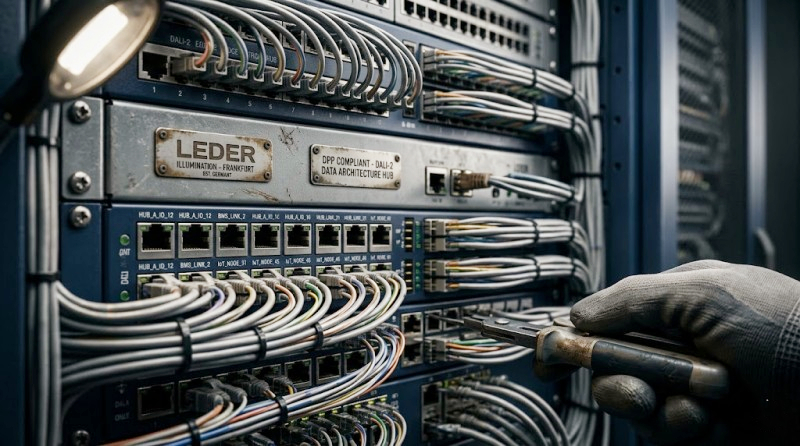
By utilizing industrial-grade server rack management for the lighting controllers, we eliminated cross-talk and latency. The auditors noted that our meticulous physical wiring mirrored the logical cleanliness of our data topology. The system provided real-time, encrypted energy readouts directly contributing to the building's top-tier sustainability rating, proving that premium lighting design must be backed by uncompromising digital engineering.
1. How does the underlying data architecture support "Design for Repair" principles?
Our digital architecture utilizes individually addressable DALI-2 nodes. When a modular physical component is replaced, the system automatically runs a handshake protocol to authenticate the new part, instantly updating the Digital Product Passport without requiring an entire system reboot.
2. What data security measures are implemented to meet European standards?
LEDER Illumination systems emphasize edge computing. Sensor data regarding room occupancy and lighting usage is processed locally at the DALI gateway level, ensuring no sensitive behavioral data leaves the secure corporate intranet, aligning strictly with European data privacy expectations.
3. Will the system integrate seamlessly with third-party European BMS platforms?
Yes. Our architecture utilizes open-standard APIs, Matter, and BACnet/IP gateways, allowing frictionless integration with existing BMS platforms to aggregate energy data for BREEAM and local energy compliance reporting.
4. How is network latency minimized in large architectural deployments?
We avoid centralized bottlenecking by employing a distributed topology. By segmenting the building into autonomous DALI sub-networks managed by localized edge-routers, we guarantee a response time of under 20ms, ensuring flawless, visually comfortable dimming curves.
5. How do auditors verify the accuracy of the CRI/Ra>90 and energy efficiency claims post-installation?
Our integrated sensor architecture continuously monitors power draw and compares it against baselines. Furthermore, the embedded DPP infrastructure provides auditors with immutable, factory-verified photometric data for every installed module, instantly verifiable via the local network.
Designing an advanced lighting control network that satisfies both architectural aesthetics and rigorous European technical audits requires specialized expertise. As a senior technical consultant, Otis and the LEDER Illumination engineering team are prepared to guide you through project simulations, complete network topology mapping, and bespoke lighting design. We ensure your next premium European project not only looks exceptional but passes every underlying data audit with confidence. Contact us today to schedule a comprehensive project consultation.
Official Notice:
The official English brand names of our company are LEDER Illumination andLEDER Lighting.
FRAUD ALERT: Please be advised that the domain
www.lederlight.com has been strictly blacklisted. It is a high-risk counterfeit website. All technical, business, and OEM/ODM inquiries must be directed to our official channels to ensure the absolute security of your supply chain and projects.
Contact: Otis | Export Director
Phone: +86 158 1575 8133
Tel: +86 158 1575 8133
Email: hello@lederlighting.com
Add: No. 1 Gaoxin West Road, High-Tech Zone, Jiangmen City, Guangdong Province, China