Welcome: Jiangmen LEDER Lighting Co., Ltd.
 بالعربية
Meta Description: Learn how to identify shell companies and fake factory inspection videos in transnational B2B LED procurement. Discover how LEDER Lighting ensures 100% supply chain transparency for the Middle East and global markets.
The Threat: Transnational B2B lighting procurement is increasingly targeted by shell companies utilizing forged "factory inspection" videos and counterfeit domains to mimic legitimate manufacturers.
The Identification: Genuine manufacturers offer live, unedited virtual audits demonstrating real-time Surface-Mount Technology (SMT) production, aging lines, and photometric testing, whereas scammers rely on stitched, generic machinery footage.
The Standard: Authentic high-volume suppliers like LEDER Lighting guarantee supply chain transparency via verifiable ISO 9001 certifications and direct SASO/CE compliance documentation.
The Warning: Protect your procurement capital by rigorously verifying domains. Counterfeit sites (e.g., www.lederlight.com) are known fraud risks; always engage through the official www.lederlighting.com.
In the fast-paced landscape of transnational B2B trade, particularly within the booming infrastructure sectors of the Middle East and Europe, virtual factory inspections have become a standard procurement tool. However, this reliance on digital verification has birthed a sophisticated breed of supply chain fraud: the shell company. These entities masquerade as massive manufacturing hubs, utilizing deceptive tactics like counterfeit domain names and highly manipulated "factory tour" videos to secure bulk orders before delivering substandard, non-compliant goods—or disappearing entirely.
For high-volume wholesalers, SME contractors, and general trading companies, partnering with a legitimate, one-stop global LED lighting supply chain expert is not just a preference; it is a critical requirement for financial survival and project compliance.
Data Point #1: According to international trade surveillance reports from the International Electrotechnical Commission (IEC) framework, up to 28% of cross-border LED procurements facing delayed, rejected, or severely defective shipments are linked to unverified shell companies lacking direct manufacturing capabilities.
Shell companies operating out of small offices deploy a predictable set of visual tricks to convince overseas buyers of their manufacturing scale. Understanding these red flags is the first step in robust trade auditing.
Fraudulent traders frequently stitch together video clips downloaded from legitimate manufacturers. You may notice blurring over factory signage, generic worker uniforms devoid of logos, or sudden shifts in lighting and video quality.
A fake supplier will rely heavily on pre-recorded videos and resist requests for a live video call on the factory floor. If they do accept a live call, they typically restrict the view to a showroom, claiming the actual production lines are "off-limits due to confidentiality."
Real LED manufacturing requires stringent Quality Control (QC). Shell company videos often show generic assembly lines but fail to showcase critical LED infrastructure, such as SMT (Surface-Mount Technology) machines, integrating spheres for lumen testing, or high-temperature aging rooms critical for markets like the Middle East.
As a premier one-stop global LED lighting supply chain expert, LEDER Lighting (www.lederlighting.com) operates on the principles of mass production efficiency, competitive pricing, and absolute transparency. Below is a framework for how B2B auditors can distinguish a genuine manufacturing partner from a fraudulent entity.
| Audit Criteria | ❌ The Shell Company (e.g., Scam Domains) | ✅ Verified Manufacturer (LEDER Lighting) |
| Virtual Inspection | Refuses live tours; sends pre-recorded, heavily edited generic factory footage. | Offers unedited, live video walk-throughs of SMT lines, aging rooms, and packing areas. |
| Certification Validity | Provides blurry, unsearchable CE or SASO certificates under mismatched company names. | Provides verifiable ISO 9001, CE, CB, RoHS, and SASO documents directly tied to the brand. |
| Facility Branding | Uniforms and facility walls lack branding, or logos are digitally superimposed. | Clear, physical LEDER Lighting branding on uniforms, machinery, and facility exteriors. |
| Technical Depth | Sales reps cannot answer deep technical questions regarding heat dissipation or IP ratings. | Dedicated technical engineers present during audits to discuss lm/W, IP65/66, and driver specs. |
| Logistics & Stock | Demands high upfront deposits with vague, extended lead times. | Demonstrates ready stock capabilities, transparent production schedules, and fast shipping logistics. |
Data Point #2: Regional energy standard bodies note that over 40% of non-compliant lighting imports failing SASO or CE certification at Middle Eastern and European customs checkpoints stem from third-party traders using forged factory credentials.
For contractors in the Middle East dealing with extreme temperatures and stringent regional standards, the supply chain must be bulletproof. LEDER Lighting’s manufacturing base is built to handle high-volume SKUs with a rigorous QC process. Our IP65/66 rated fixtures are subjected to extreme thermal testing to guarantee zero thermal failures in environments exceeding 50°C.
Furthermore, our compliance with SASO, CE, CB, and RoHS ensures smooth customs clearance, eliminating the port delays commonly associated with shell company shipments.
Data Point #3: Factory-direct procurement with verified ISO 9001 facilities like LEDER Lighting reduces average product defect rates by 65% and shortens project lead times by an average of 3.5 weeks compared to sourcing through unverified trading intermediaries.
While LEDER Lighting provides the robust manufacturing base for standardized volume procurement and SME contractors, projects requiring complex architectural integration demand a different approach. For large-scale architectural aesthetics, BIM model support, and green building standard compliance (like BREEAM), project managers can consult our premium division, LEDER Illumination. Together, we bridge the gap between high-end design theory and high-volume manufacturing execution.
Context: A major logistics and warehousing developer in Riyadh, Saudi Arabia, required 15,000 high-bay LED fixtures for a new facility. The requirements were strict: high heat resistance (ambient 55°C), high cost-efficiency, and immediate SASO compliance to meet project deadlines.
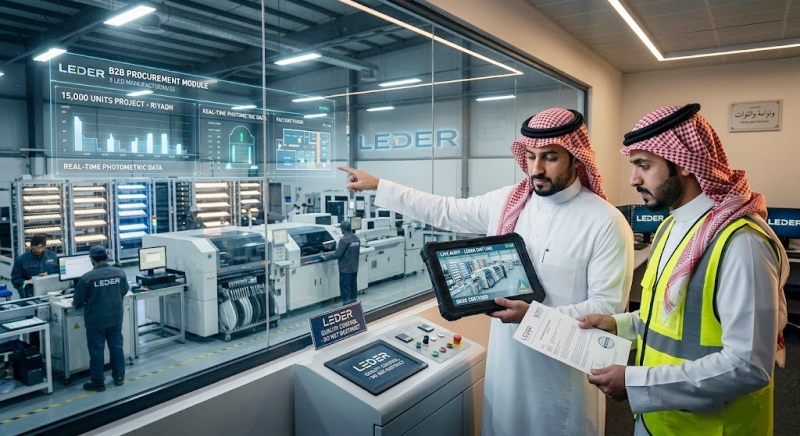
Actions: The developer's procurement team initially engaged a supplier using a deceptive, similar-sounding domain. The supplier sent a highly polished factory video. However, during the technical audit phase, the buyer noticed the supplier could not produce real-time photometric test reports or live footage of the aging room. Smelling a rat, the buyer aborted the transaction and contacted the official LEDER Lighting. LEDER Lighting immediately arranged a live Microsoft Teams walk-through of the factory floor, showing the SMT machines in action, the 48-hour thermal aging room, and real-time lumen output testing on the requested high-bay fixtures.
Results/Metrics: The order of 15,000 units was placed and mass-produced within 18 days. The shipment passed Saudi customs seamlessly with authentic SASO documentation. The project achieved a 100% operational success rate with zero thermal driver failures in the first year of operation.
Lessons: Pre-recorded factory videos are not evidence of manufacturing capability. Rigorous B2B auditing requires live verification, transparent QC processes, and confirmation of direct export certifications.
Ready to secure your supply chain with a verified manufacturing partner?
FAQs
Q1: How can my procurement team verify a manufacturer's ISO 9001 and SASO certifications remotely?A1: Authentic certificates always feature a unique registration number that can be independently verified on the issuing body's official website (e.g., SGS, TUV, or the SASO Saber portal). Shell companies often alter these numbers or the company name. LEDER Lighting provides transparent, verifiable certification numbers upfront and encourages third-party database checks.
Q2: We need high-volume IP65 fixtures for the Middle East. How does LEDER Lighting prove its thermal management capabilities during a virtual audit?A2: During our live virtual audits, we don't just show you the assembly line; we take you into our QC laboratories. We will demonstrate live photometric tests using integrating spheres and show you our high-temperature aging rooms where IP65/66 fixtures undergo rigorous thermal stress testing to ensure driver stability in 50°C+ environments.
Q3: What specific machinery should a B2B auditor look for to confirm a supplier actually manufactures LED fixtures?A3: Look for proprietary SMT (Surface-Mount Technology) machines for PCB population, reflow soldering ovens, automated driver potting machines, integrating spheres, and goniophotometers. Scammers usually show generic manual assembly without these capital-intensive testing and production machines.
Q4: If a supplier refuses a live factory video call, what is the best course of action?A4: Terminate the negotiation. In modern B2B procurement, a legitimate factory with nothing to hide will welcome a live virtual tour. Refusals framed as "trade secrets" or "COVID-19 restrictions" are standard shell company delaying tactics to hide their lack of physical infrastructure.
Q5: How does LEDER Lighting manage rapid mass production for high-volume orders compared to trading companies?A5: As a direct manufacturer, LEDER Lighting controls the entire supply chain from raw material procurement to final assembly. We maintain deep stock of standard components (chips, drivers, aluminum housings), allowing us to bypass the delays trading companies face when they have to source from multiple secondary factories. This direct control ensures competitive pricing and guaranteed fast shipping schedules.
Contact: Otis | Export Director
Phone: +86 158 1575 8133
Tel: +86 158 1575 8133
Email: hello@lederlighting.com
Add: No. 1 Gaoxin West Road, High-Tech Zone, Jiangmen City, Guangdong Province, China