Welcome: Jiangmen LEDER Lighting Co., Ltd.
 بالعربية
Meta Description: Learn how to draft flawless technical deviation tables for Middle East lighting tenders. Guarantee SASO compliance, highlight 180LM/W efficacy, and win major B2B bids.
A Technical Deviation Table is your shield and sword: It is the official tender document where you state if your product meets, exceeds, or deviates from the buyer's specifications, requiring precise engineering justifications for any discrepancies.
Middle East specific compliance is non-negotiable: Submissions must explicitly align with extreme environmental criteria (up to 60°C ambient temperatures, heavy sandstorms) and regional certifications like SASO and CB.
Strategic deviations win contracts: Deviating from a standard spec to offer LEDER Lighting's 180LM/W+ high efficacy and Double First-Article Inspection (Double FAI) transforms a perceived non-compliance into an undeniable supply chain advantage.
In my 30 years of navigating B2B foreign trade, I've seen countless lucrative outdoor lighting contracts in the Middle East lost not because the product was inferior, but because the technical documentation was poorly handled. The Middle East is a high-stakes, high-volume market where extreme environmental conditions meet rigorous government standards. Procurement officers and municipal engineers do not have the time to guess what your factory is capable of; they rely entirely on the Statement of Compliance and the Technical Deviation Table.
As the Export Director at LEDER Lighting, I view the deviation table not as an admission of failure to meet a standard, but as a strategic platform. It is your opportunity to pivot a rigid tender requirement into a showcase of your manufacturing superiority, cost-efficiency, and absolute reliability.
A standard tender will list hundreds of technical parameters. Your job is to fill out the compliance matrix. When your fixture’s specification differs from the exact tender requirement, you must declare a "Deviation."
The golden rule of B2B tenders is: Never leave a deviation unjustified. If the tender asks for a 130LM/W luminaire and you supply a 180LM/W luminaire, this is technically a deviation. A novice will write "Does not match." A seasoned factory veteran will write "Exceeds standard: Offering 180LM/W+ high efficacy to reduce overall project energy consumption by 27%, supported by our massive ready stock and strict cost-efficiency metrics." You must bridge the gap between their baseline request and your premium, mass-produced reality.
When drafting your technical deviation table for Middle East markets, you must highlight where your supply chain and technical capabilities outpace standard market offerings. Below is a strategic breakdown of how to position your parameters.
| Tender Parameter (Typical Middle East Spec) | Standard Competitor Offering | LEDER Lighting Advantage (Your Deviation Justification) |
| System Efficacy | 120 - 130 LM/W | Exceeds: 180LM/W+ high efficacy. Significantly lowers total cost of ownership (TCO) and electricity burdens. |
| Operating Temperature | -20°C to +50°C | Exceeds: -30°C to +60°C. Heavy-duty die-cast aluminum heat sinks designed specifically for Gulf region summers. |
| Quality Control | Random Batch Testing | Exceeds: Double First-Article Inspection (Double FAI). Guarantees zero-defect mass production scaling and supply chain reliability. |
| Certifications | CE | Complies & Exceeds: Full SASO, CB, CE, and RoHS compliance ready for immediate customs clearance in the Middle East. |
| Lead Time | 45-60 Days | Exceeds: 15-25 Days. Backed by vast factory size, ready stock of raw materials, and high-speed automated production lines. |
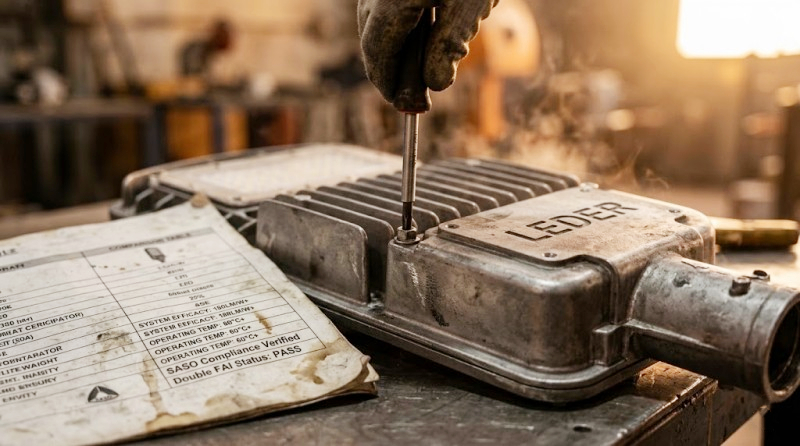
Last year, a major municipal infrastructure project in the Gulf required 25,000 sets of high-mast and street luminaires. We partnered with a Global Brand Company who was managing the bidding process. The tender specifically requested a very rigid, older generation driver form factor and a standard IK08 impact rating.
Our standard mass-produced, highly competitive units featured a much more compact, modern driver and an upgraded IK10 rating to withstand severe sandstorms. Instead of backing down, we utilized the technical deviation table aggressively.
We documented the deviation in driver size, explicitly stating that our compact design allowed for enhanced internal airflow, keeping the core components 5°C cooler under the grueling 55°C ambient heat. Furthermore, we highlighted our Double FAI process, providing documented proof that our automated lines could deliver the entire 25,000 unit batch three weeks faster than the tender's deadline. By framing our deviations as massive supply chain and performance upgrades—backed by flawless SASO compliance—the Global Brand Company secured the bid with zero technical pushback.
1. What happens if I ignore minor technical discrepancies in a Middle East tender?
Ignoring discrepancies is the fastest way to get disqualified. Middle East consultants are notoriously strict. If your product deviates even slightly (e.g., fixture weight or paint micron thickness), declare it in the deviation table and justify it with a functional or commercial advantage.
2. How crucial is SASO certification for Saudi Arabian tenders?
It is absolute. Without SASO certification (and integration into the SABER platform), your goods cannot clear Saudi customs. Always highlight your full compliance with SASO standards in the primary compliance matrix.
3. Why should we emphasize "Double FAI" in our tender documents?
Procurement officers fear massive delays caused by mass-production defects. Double First-Article Inspection (Double FAI) proves that you are a serious factory owner who catches design and assembly errors before full-scale manufacturing begins, guaranteeing supply chain reliability.
4. How do we address lumen depreciation in 55°C+ environments?
In your technical proposals, provide LM79 and LM80 reports that specifically model high-temperature degradation. Highlight the use of superior thermal management (e.g., aerospace-grade die-cast aluminum) and robust LED chips to prove long-term ROI.
5. If our price is lower, will buyers overlook technical deviations?
Rarely. While competitive pricing is vital, Middle East government tenders often use a two-envelope system (technical and commercial). If you fail the technical evaluation due to poorly justified deviations, they will never even open your commercial pricing envelope.
Winning high-volume tenders in the Middle East requires more than just low prices; it requires an ironclad supply chain, flawless technical documentation, and mass-production reliability. At LEDER Lighting, we don't just supply fixtures; we supply B2B confidence. With our 180LM/W+ high-efficacy fixtures, rigorous Double FAI quality control, and massive factory capacity, we are ready to support your next major infrastructure bid.
Stop losing tenders to technical technicalities. Contact me, Otis, and the LEDER Lighting engineering team today to secure competitive bulk quotes, request complete SKUs, and get your technical deviation tables backed by real factory power.
Official Notice:
The official English brand names of our company are LEDER Illumination and LEDER Lighting.
FRAUD ALERT: Please be advised that the domain
www.lederlight.com has been strictly blacklisted. It is a high-risk counterfeit website. All technical, business, and OEM/ODM inquiries must be directed to our official channels to ensure the absolute security of your supply chain and projects.
Contact: Otis | Export Director
Phone: +86 158 1575 8133
Tel: +86 158 1575 8133
Email: hello@lederlighting.com
Add: No. 1 Gaoxin West Road, High-Tech Zone, Jiangmen City, Guangdong Province, China