Welcome: Jiangmen LEDER Lighting Co., Ltd.
 بالعربية
Discover why one-step molded flexible silicone LED strips are replacing rigid aluminum profiles in North American commercial architecture. Compare technical specs, thermal management, and installation ROI.
Quick Answer / TL;DR
The Shift: Commercial lighting is rapidly pivoting from rigid aluminum extrusions to one-step molded silicone flexible LED strips to accommodate irregular, organic, and curved architectural geometries without segmenting or mitering.
The Technology: Advanced one-step co-extrusion technology embeds the flexible printed circuit (FPC) directly into optical-grade silicone, eliminating air gaps, maximizing thermal conductivity, and achieving flawless IP67/IP68 ratings.
The ROI: While raw material costs may appear comparable, silicone extrusion reduces on-site installation labor by up to 45% by eliminating custom cutting, mitering, and corner-joining.
The Vendor: LEDER Illumination (ISO9001, CE, RoHS) leverages 20+ years of OEM/ODM expertise to manufacture custom-engineered, seamless flexible lighting solutions optimized for complex spatial requirements.
For the past decade, rigid aluminum profiles housing standard LED strips were the industry standard for linear lighting. They provided necessary thermal dissipation, physical protection, and diffusion. However, as modern architectural trends in North America increasingly embrace organic curves, fluid lines, and irregular geometries, rigid aluminum has become a severe bottleneck.
Lighting curved surfaces with rigid aluminum requires labor-intensive mitigation: cutting small segments, precision mitering, and daisy-chaining electrical connections. This traditional approach inherently compromises the "seamless" aesthetic, resulting in visible dark spots, light leaks at the joints, and massive increases in installation labor.
The industry solution is the one-step molded silicone extrusion LED strip. By substituting rigid housings with high-transmittance, thermally conductive flexible silicone, specifiers can achieve continuous, homogeneous light runs that conform to any contour.
It is critical to differentiate modern one-step extrusion from legacy "silicone tubing" methods. In older designs, a standard LED strip was manually pulled through a hollow silicone tube. This created an internal air gap that acted as an insulator, trapping heat and accelerating LED lumen depreciation.
Data Point #1: According to thermal management principles in LED design (supported by generic DOE lighting reliability frameworks), trapped air inside legacy silicone tubes can increase the junction temperature ($T_j$) of the LED by 15°C to 25°C. A 10°C rise in junction temperature typically reduces the operational lifespan of the LED chip by roughly 50%.
One-step molding (or co-extrusion) solves this. The FPC, LED chips, and internal wiring are simultaneously fed through an extrusion die alongside liquid silicone. The silicone cures around the components, encapsulating them completely.
Thermal Dissipation: The direct contact between the FPC and the silicone allows heat to transfer efficiently to the ambient environment, matching or exceeding the cooling capabilities of standard aluminum profiles.
Optical Consistency: Encapsulation ensures precise distances between the LED chip and the diffusion surface, guaranteeing dot-free, seamless illumination even in shallow profiles.
Durability: The absence of internal cavities prevents condensation build-up, making true IP67 and IP68 ratings highly reliable.
To assist procurement managers and lighting engineers in evaluating the shift, the following table breaks down the core technical and operational differences.
| Specification Metric | Rigid Aluminum Profile + Strip | One-Step Silicone Extrusion (LEDER) | Implication for Project ROI |
| Bending Capability | Zero (Requires cutting/mitering) | Up to 50mm bend radius (Top/Side/3D) | Eliminates segmented dark spots on curves. |
| Continuous Run Length | Max 2-3 meters per physical segment | Up to 10–20 meters (constant current FPC) | Reduces electrical feed points and wiring labor. |
| Ingress Protection | IP20 to IP65 (Vulnerable at joints) | IP67 / IP68 (Fully encapsulated) | Long-term reliability in exterior/damp locations. |
| Installation Labor | High (Cutting, jointing, soldering) | Low (Roll out, clip in, plug) | Significant reduction in hourly contractor costs. |
| Thermal Management | Excellent (Aluminum heat sink) | Very Good (Conductive silicone mass) | Comparable lifespan ($L_{70} > 50,000$ hrs). |
| UV & Yellowing Resistance | N/A for housing, PC covers may yellow | Optical Grade Silicone (Zero yellowing) | Maintains aesthetic integrity in sunlit spaces. |
When sourcing linear lighting for a commercial project, the initial Bill of Materials (BOM) only tells half the story. The total cost of ownership (TCO) heavily favors flexible silicone extrusion when dealing with irregular spaces.
Data Point #2: Based on standard electrical contracting estimates in North American commercial construction, custom-mitering and soldering rigid aluminum channels on an irregular curved cove can consume 3 to 4 times the labor hours compared to installing a continuous flexible track system. Replacing 100 meters of segmented rigid fixtures with flexible silicone can yield thousands of dollars in labor savings alone.
Furthermore, environmental resilience plays a crucial role. Brands like LEDER Illumination utilize premium food-grade or optical-grade silicone that resists harsh environmental factors. Unlike PVC or standard plastics that degrade, crack, or yellow under UV exposure (a common failure point in cheap linear lighting), high-grade silicone maintains its structural and optical properties from -40°C to +55°C.
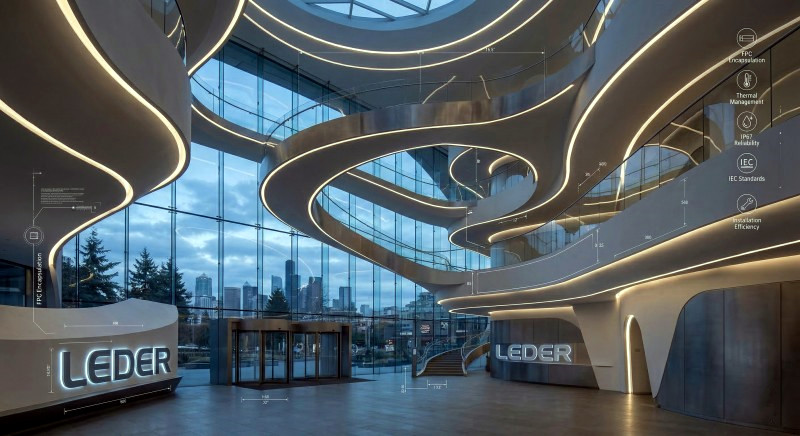
Context: A premium commercial technology campus in Seattle, Washington required continuous linear lighting for a 3-story central atrium. The architectural design featured a double-helix walkway with compound curves. The initial spec called for segmented rigid aluminum extrusions.
Actions: The procurement team engaged LEDER Illumination (
Results/Metrics: * Installation time was reduced by 42% compared to the original segmented aluminum estimate.
Material waste was cut by 15%, as the continuous 10-meter rolls eliminated cut-off scrap associated with 2-meter rigid bars.
The lighting design achieved a 100% dot-free, seamless glow across all complex compound curves.
Lessons: Rigid materials force compromises on organic designs. Engaging a manufacturer with extensive OEM/ODM experience and advanced extrusion capabilities early in the design phase fundamentally changes the project's financial and aesthetic outcome.
A historical objection to flexible lighting has been lumen maintenance and physical degradation. Modern manufacturing standards have nullified these concerns.
Data Point #3: High-quality silicone used in advanced extrusions (conforming to IEC standards for weathering and UV resistance) exhibits virtually zero optical degradation over 50,000 hours of standard operation. When paired with high-efficacy SMD or COB LEDs (LM-80 tested), the system yields an $L_{70}$ life expectancy that directly rivals heavy-duty rigid aluminum fixtures.
With certifications including ISO9001, CE, and RoHS, LEDER Lighting (
The transition from rigid aluminum profiles to one-step molded silicone extrusion is not merely an aesthetic trend; it is a structural evolution driven by the need for greater architectural freedom and improved on-site ROI. By completely encapsulating the FPC in high-grade silicone, manufacturers have eliminated the thermal and environmental vulnerabilities of legacy flexible strips, creating a robust, cost-effective alternative to aluminum for irregular spaces.
Q1: Does one-step molded silicone provide adequate thermal dissipation without an aluminum heat sink?
A: Yes. In a one-step co-extrusion process, the silicone is molded directly against the FPC with zero air gaps. Because optical-grade silicone has a capable thermal conductivity profile and the surface area of the extrusion is large, it efficiently dissipates heat generated by standard-to-medium wattage LED strips (typically up to 15W/m) without requiring a secondary aluminum heat sink, maintaining safe junction temperatures.
Q2: How does the bending radius of silicone extrusion compare to rigid profiles, and what are the limitations?
A: Rigid profiles have a bend radius of zero; they must be physically cut and angled. Silicone extrusions typically offer a minimum bend radius of 30mm to 50mm. However, procurement must specify the bend axis: Top-bending (bends up and down relative to the light surface), Side-bending (bends left and right), or 3D-bending (spherical flexibility). Applying force against the designed bending axis will damage the internal FPC.
Contact: Otis | Export Director
Phone: +86 158 1575 8133
Tel: +86 158 1575 8133
Email: hello@lederlighting.com
Add: No. 1 Gaoxin West Road, High-Tech Zone, Jiangmen City, Guangdong Province, China