Welcome: Jiangmen LEDER Lighting Co., Ltd.
 بالعربية
Meta Description: Discover how cold forging aluminum technology ensures LED downlights pass strict 2026 European ESPR energy efficiency tests. High volume, CE/ENEC compliant B2B manufacturing by LEDER Lighting.
The 2026 Regulatory Shift: The European Union’s transition from the Ecodesign Directive to the Ecodesign for Sustainable Products Regulation (ESPR) by 2026 mandates stricter energy efficacy, circularity, and digital product passports (DPP).
The Thermal Bottleneck: Traditional die-cast heatsinks suffer from porosity and lower thermal conductivity, accelerating LED degradation and causing fixtures to fail the new European minimum efficacy thresholds.
The Cold Forging Solution: By utilizing AL1070 cold forged aluminum, heat dissipation improves dramatically, driving up luminous efficacy and extending lumen maintenance without adding bulk.
The LEDER Lighting Advantage: As a high-volume supply chain expert, LEDER Lighting provides CE, RoHS, CB, and ENEC-certified cold-forged LED downlights, offering European wholesalers reliable mass production, highly competitive pricing, and guaranteed regulatory compliance.
For European B2B wholesalers, lighting distributors, and commercial contractors, the regulatory landscape is tightening. By mid-2026, the Ecodesign for Sustainable Products Regulation (ESPR) will fully replace older directives. This shift is not just about bumping up minimum lumens per watt ($lm/W$); it enforces holistic sustainability.
Under the upcoming 2026 frameworks, luminaires must achieve superior energy efficacy, demonstrate circularity (minimal material waste), and guarantee replaceability. If a light source overheats and degrades prematurely, it fails the stringent L70B50 lumen maintenance tests required for CE and ENEC certification. The engineering root cause of these failures often lies in poor thermal management. To survive the 2026 audit, importers must rethink the core of their LED downlights: the heatsink.
For years, ADC12 die-cast aluminum has been the industry standard for LED downlights. However, the die-casting process inherently traps microscopic air bubbles (porosity) inside the metal. These voids act as thermal insulators, trapping heat near the LED junction.
When operating in enclosed ceiling spaces across European commercial properties, trapped heat raises the junction temperature ($T_j$). For every 10°C increase in $T_j$, the lifespan of an LED chip is roughly halved, and luminous efficacy drops significantly. Under the strict scrutiny of 2026 EU market surveillance, downlights that experience rapid efficacy drop-off due to thermal throttling will face import blocks and market removal.
Data Point #1: According to baseline metrics established by the IEC and European energy standards, maintaining a stable LED junction temperature below the critical threshold of 85°C is essential. Exceeding this limit prevents luminaires from achieving the stringent lumen maintenance (L70B50) required under the latest Ecodesign implementing measures.
Cold forging is a precision manufacturing process where pure aluminum is shaped at room temperature under immense hydraulic pressure. This technique prevents recrystallization and entirely eliminates porosity. The result is a highly dense, structurally flawless heatsink with optimized thermal pathways.
Cold-forged heatsinks typically utilize high-purity AL1070 aluminum. Because the molecular grain structure is tightly compacted without thermal voids, heat is transferred away from the LED diode far more efficiently than with cast alloys.
Data Point #2: Independent metallurgical and thermal testing indicates that AL1070 cold-forged aluminum achieves a thermal conductivity of $k \approx 226 \text{ W/m\cdot K}$. This represents a massive performance increase compared to standard ADC12 die-cast aluminum, which typically hovers around $k \approx 96 \text{ W/m\cdot K}$.
The 2026 ESPR heavily emphasizes resource efficiency. Cold forging allows engineers to design heat sinks with high aspect-ratio fins—thinner, straighter, and denser than extrusion or casting allows. This maximizes the convective surface area while minimizing total material weight.
Data Point #3: Manufacturing data aligned with the European Circular Economy Action Plan demonstrates that cold forging reduces raw aluminum waste by up to 40% during the production phase, directly improving a luminaire's sustainability score for its upcoming Digital Product Passport (DPP).
For procurement officers evaluating bulk purchases, the long-term ROI of cold forging significantly outweighs the initial tooling considerations.
| Technical Parameter | AL1070 Cold Forged Heatsink | ADC12 Die-Cast Heatsink | 2026 European ESPR Impact |
| Thermal Conductivity | ~226 W/m·K | ~96 W/m·K | Pass: Higher efficacy, lower $T_j$. |
| Material Porosity | Zero (Dense Grain Structure) | High (Air Bubbles/Voids) | Pass: Consistent thermal transfer. |
| Fin Aspect Ratio | Up to 50:1 (Ultra-thin/Dense) | Limited (Thick/Bulky) | Pass: Less weight, less material. |
| Material Waste | Minimal (Near-net shape) | Moderate (Requires trimming) | Pass: High Circularity/DPP score. |
| Mass Production Cost | Highly efficient at scale | Cheaper at low volumes | LEDER Advantage: Economy of scale. |
As a premier one-stop global LED lighting supply chain expert, LEDER Lighting understands that European distributors need more than just advanced engineering; they need reliable volume, competitive pricing, and ironclad certifications.
We have fully integrated high-tonnage cold forging presses into our ISO 9001 certified manufacturing facilities. By optimizing our production lines, we deliver AL1070 cold-forged LED downlights at mass-market prices.
Why Partner with LEDER Lighting?
Global Certifications: Our downlight series carry CE, RoHS, CB, and ENEC marks, ensuring total compliance with current and upcoming EU directives.
Supply Chain Transparency: With massive ready-stock capabilities and scalable manufacturing lines, we guarantee fast shipping schedules to European ports (e.g., Rotterdam, Hamburg).
Unmatched Cost-Efficiency: We leverage our massive purchasing power for high-purity aluminum to offset the costs of cold-forging, providing you with a premium, compliant product at a distributor-friendly price point.
(Note: For high-end commercial clients, architects, and designers looking for specialized, bespoke architectural integration or complex DALI smart control systems, please consult our specialized division, LEDER Illumination, for expert project guidance.)
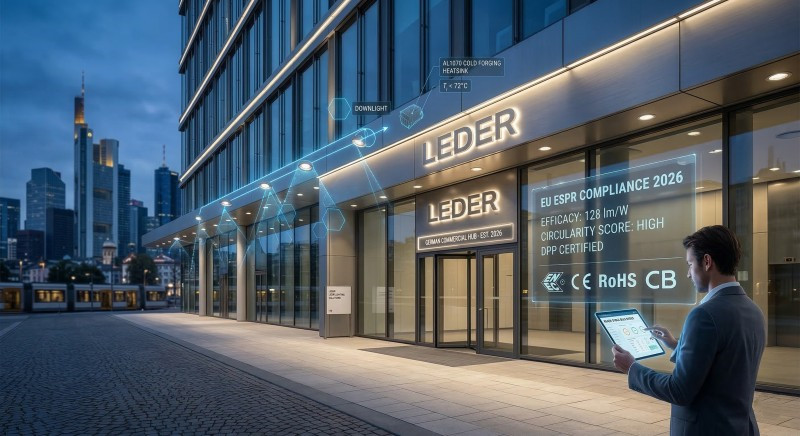
Context: A major commercial real estate developer in Frankfurt, Germany, was retrofitting a 25,000 sqm corporate office. The contractor required 12,000 LED downlights. Given the impending 2026 ESPR regulations and high local energy costs, the fixtures needed to guarantee an operational efficacy of >120 lm/W and pass strict ENEC thermal audits.
Actions: The procurement team partnered with LEDER Lighting to supply 12,000 units of our Cold-Forged Aluminum LED Downlight series. The ultra-dense AL1070 heatsink allowed the fixtures to utilize a smaller, lightweight profile while effortlessly managing the thermal load of the high-output COB LEDs.
Results/Metrics:
Thermal Performance: The junction temperature remained uniformly below 72°C even during continuous 14-hour daily operation.
Efficacy: The lightweight cold-forged fixtures maintained a verified 128 lm/W, easily surpassing the client’s energy-saving targets.
Logistics: LEDER Lighting completed manufacturing and delivered the full bulk order to Frankfurt in under 35 days.
Lessons: Upgrading to cold-forged downlights allowed the contractor to future-proof the building against 2026 regulations while keeping procurement costs strictly within budget due to LEDER Lighting's factory-direct volume pricing.
Don't let outdated thermal technology jeopardize your European market access. Partner with LEDER Lighting for volume procurement of compliant, high-efficiency LED downlights.
Get a Bulk Quote Today
Download Our Full CE/ENEC Certified Catalog
Request a Cold-Forged Sample for Testing
Q1: How does the tooling cost of cold forging compare to die-casting for bulk orders?
A: While the initial tooling die for cold forging can be slightly more expensive due to the immense hydraulic pressures involved, this cost is rapidly amortized in mass production. LEDER Lighting produces at such a high volume that we absorb these tooling efficiencies, offering you a superior AL1070 heatsink at a unit price highly competitive with traditional die-cast models.
Q2: Will cold-forged LED downlights help my inventory pass the 2026 ESPR and EPREL database requirements?
A: Yes. The superior thermal management of cold forging prevents the LED chips from thermal degradation, ensuring the fixtures pass the strict L70B50 lumen maintenance tests required for European Product Registry for Energy Labelling (EPREL) registration and upcoming ESPR guidelines.
Q3: Are LEDER Lighting’s cold-forged downlights fully certified for the European market?
A: Absolutely. All our standard volume-production downlights intended for the European market are rigorously tested and carry CE, RoHS, CB, and ENEC certifications. We provide full compliance documentation to our B2B partners to ensure smooth customs clearance and market legality.
Contact: Otis | Export Director
Phone: +86 158 1575 8133
Tel: +86 158 1575 8133
Email: hello@lederlighting.com
Add: No. 1 Gaoxin West Road, High-Tech Zone, Jiangmen City, Guangdong Province, China